Getting more website traffic is only useful if enough of that traffic eventually does something valuable.
For one Malaysian business, that might mean purchasing a product.
For another, it could mean,
- requesting a quotation
- booking a consultation
- submitting an enquiry
- calling the business
- starting a WhatsApp conversation
- signing up for a trial
- scheduling a demo
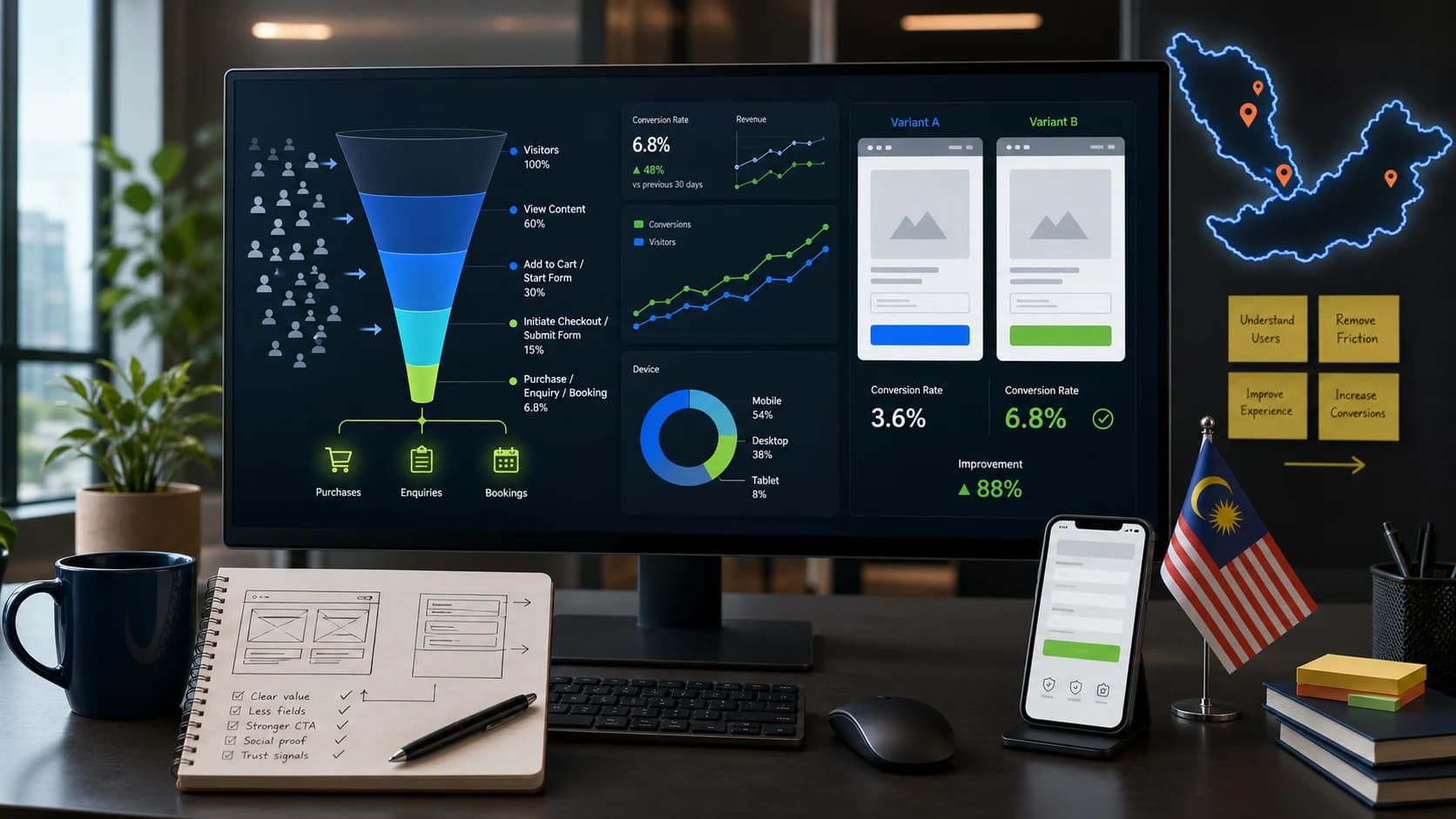
Conversion Rate Optimisation, usually shortened to CRO, is the process of improving the experience so that a greater proportion of appropriate visitors complete those valuable actions.
That does not mean persuading every visitor to buy.
Some visitors are researching. Some are the wrong audience. Some are not ready.
Good CRO focuses on removing unnecessary friction for the people who are genuinely interested.
That is particularly relevant in Malaysia, where DataReportal estimates that 35.4 million people were using the internet by the end of 2025, representing 98% internet penetration. Malaysia also had 44 million active cellular mobile connections.
For many businesses, the problem is no longer simply getting online.
It is turning more of the attention they already pay to acquire into business.
Understanding the Cost
A company receiving thousands of paid visitors every day has very different CRO requirements from an SME generating a few hundred website visits each month.
An ecommerce store may need work across:
- product pages
- category pages
- cart
- checkout
- payments
A B2B company may need improvements to:
- service pages
- case studies
- enquiry forms
- demo booking
- qualification
- sales handoff
The cost also changes depending on whether you are purchasing:
- Analysis only
- or
Analysis, design, development, experimentation and ongoing optimisation.
Current Malaysian CRO content already reflects these differences. Local guides distinguish ecommerce CRO from B2B optimisation because the customer journeys, conversion events and testing opportunities are not the same.
So instead of asking only:
- "How much does CRO cost?"
ask:
- "Where are we currently losing valuable customers, and what will it take to fix that?"
What is a Conversion Rate?
The basic calculation is,
- Conversion rate = conversions ÷ visitors or sessions × 100
If 1,000 relevant visitors reach a landing page and 40 submit an enquiry, the conversion rate using sessions as the denominator would be 4%.
The important part is consistency.
Do not compare a user-based conversion rate in one report with a session-based rate in another and assume they measure exactly the same thing.
Google Analytics 4 uses events to measure interactions such as page views, clicks and purchases, while important business actions can be marked as key events.
And do not obsess over whether your conversion rate is above some universal benchmark.
There is no single conversion rate that represents "good" performance across every industry and business model. Baymard makes the same point for ecommerce specifically: conversion performance depends on the context and many individual customer-experience decisions.
A better benchmark is often:
your current performance versus what you can improve through controlled changes.
CRO starts with Choosing the Right Conversion
Imagine a service company tracking these actions:
- viewed contact page
- clicked WhatsApp
- submitted form
- booked meeting
- became customer
All five are useful.
But they are not equally valuable.
A CRO programme should distinguish between micro conversions and primary business conversions.
Micro Conversions
These indicate progress.
Examples:
- viewing pricing
- watching a video
- downloading a brochure
- starting checkout
- adding a product to cart
Primary Conversions
These are closer to the actual business objective.
Examples:
- completed purchase
- qualified enquiry
- booked consultation
- subscription
- demo booking
Google Analytics now distinguishes ordinary events from key events that represent actions important to the business. Those key events can also be used for conversion measurement in Google Ads where relevant.
If you optimise the wrong action, you can improve the dashboard while making little difference to revenue.
Fix Measurement before Redesigning Anything
Before changing the website, confirm that your data can be trusted.
Check
- GA4 installation
Google Tag Manager
- form submission events
- ecommerce purchase events
- WhatsApp clicks
- calls
- booking completions
- duplicate events
- checkout events
- thank-you pages
- payment confirmation
- CRM outcomes where possible
Google recommends event-based measurement for website interactions and provides debugging tools for validating whether those events are being recorded correctly.
For single-page applications, measurement needs extra attention because URL and screen changes may happen without conventional full-page reloads. Google provides separate GA4 guidance for measuring those experiences.
This matters for modern React and Next.js websites.
A beautiful analytics dashboard is not useful when one purchase fires twice or the main enquiry form is not tracked at all.
Do Not Blame the Website for Bad Traffic
Conversion rate is partly a website metric.
It is also a traffic-quality metric.
Imagine two campaigns.
- Campaign A
People searched directly for:
- commercial cleaning company Kuala Lumpur
- Campaign B
People clicked a broad social advertisement because the creative looked interesting.
You should not automatically expect those audiences to convert at the same rate.
One arrives with stronger existing intent.
This is why CRO needs to connect with acquisition.
Kaina's Google and Meta Ads services can help assess whether targeting and campaign intent match the destination page.
Likewise, SEO services in Malaysia should direct searchers towards pages that match what they were actually looking for.
Before redesigning a landing page, ask:
Is the right audience reaching it?
Sometimes the biggest CRO improvement happens before the visitor arrives.
Find Where People Drop Out
Do not begin CRO with:
- "Let's change the button."
Begin with:
- "Where is the funnel leaking?"
For ecommerce, track stages such as:
- Landing page → Product → Add to Cart → Checkout → Purchase
For lead generation:
- Landing page → Service information → Form start → Form submission → Qualified lead
If 70% of visitors leave before viewing a service in detail, the problem is probably different from a website where many people begin the form but never finish it.
This is why funnel analysis should come before individual design changes.
Use Heatmaps and Session Recordings to Understand Why
Analytics tells you what happened.
Behaviour tools can help explain why.
Microsoft Clarity currently provides session recordings that show clicks, taps, scrolling and navigation, alongside heatmaps that aggregate where visitors click and how far they scroll.
Look for:
- rage clicks
- dead clicks
- buttons people miss
- visitors repeatedly scrolling
- forms people abandon
- mobile navigation problems
- confusing pop-ups
- information users search for repeatedly
- important sections very few visitors reach
Do not watch ten random recordings and redesign the site based on one unusual visitor.
Look for patterns.
Then combine behavioural observations with quantitative analytics.
Prioritise High-Value Pages
You do not need to optimise every page simultaneously.
Start where conversion improvement can produce the greatest commercial impact.
For a service business:
- paid landing pages
- high-traffic service pages
- pricing or comparison pages
- contact and enquiry flows
- homepage
For ecommerce:
- high-revenue product pages
- major category pages
- cart
- checkout
- mobile navigation
A page receiving 50 visits a month should not necessarily receive more testing resources than a page receiving 10,000 qualified visits.
Prioritise according to
- Traffic × Commercial value × Evidence of friction
CRO for Lead Generation Websites
For a B2B or service company, the visitor is rarely deciding whether to click a colourful button.
They are deciding whether contacting you is worth their time.
Your page needs to answer:
Do you solve my problem?
Do you work with businesses like mine?
Why should I trust you?
What will happen after I enquire?
Strong lead-generation pages may include:
- clear positioning
- specific services
- client examples
- case studies
- testimonials
- process explanation
- realistic expectations
- FAQs
- clear CTA
- low-friction enquiry process
Current Malaysian B2B CRO guidance similarly focuses on trust, service clarity, forms and the buying journey rather than treating conversion optimisation purely as visual design.
Do Not Ask for Information You Do Not Need
Long forms can improve qualification in some cases.
They can also reduce completion.
The right form balances conversion rate and lead quality.
A three-field form that generates 100 poor enquiries may be worse than a six-field form that produces 40 highly qualified ones.
CRO should therefore optimise towards the business outcome, not maximum form completion.
CRO for Ecommerce Websites
Ecommerce has a longer visible funnel.
You can analyse:
- product views
- add-to-cart rate
- cart progression
- checkout start
- payment
- purchase
Checkout deserves particular attention.
Baymard's current benchmark places average documented cart abandonment at roughly 70%, and its checkout research finds that many ecommerce sites still have substantial usability problems.
Baymard also reports that 18% of users in its research have abandoned orders because the checkout was too long or complicated.
Common areas to examine include:
- unexpected costs
- delivery information
- payment options
- guest checkout
- form complexity
- coupon-code distractions
- account creation
- error messages
- trust
- mobile payment flow
Do not blindly copy Amazon or another major retailer.
Your customers, brand familiarity, average order value and catalogue may be completely different.
Mobile CRO Deserves Its Own Review
Do not assume that a responsive website is automatically easy to convert on.
Malaysia had 44 million cellular connections at the end of 2025, and 99.3% of those connections were classified as broadband-capable.
Review the conversion journey on a real phone.
Check
- menu usability
- sticky buttons
- WhatsApp buttons
- form keyboards
- autofill
- text size
- tap targets
- product galleries
- payment
- pop-ups
- cookie banners
- chat widgets
A desktop conversion issue and a mobile conversion issue may have completely different causes.
Segment your analytics by device before assuming one solution fits both.
Page Speed Matters, but Do Not Turn CRO Into a Speed Score Competition
A slow page creates friction.
But a fast page with an unclear offer can still convert poorly.
Google's current Core Web Vitals measure loading performance, responsiveness and visual stability through LCP, INP and CLS. Google's recommended "good" thresholds are LCP within 2.5 seconds, INP below 200 milliseconds and CLS below 0.1.
Google also recommends taking a broader view of page experience rather than focusing on a single technical score.
For CRO, investigate performance when it affects real customer behaviour.
For example:
- checkout becomes unresponsive
- mobile menu takes too long
- layout moves while somebody taps
- payment widget delays loading
- form submission appears broken
Those are business problems, not simply Lighthouse warnings.
When implementation is required, Kaina's website design and development services can address UX, performance and conversion-path changes rather than treating CRO as a reporting exercise.
Trust Is Often a Bigger Problem Than Design
A polished interface does not automatically make a visitor comfortable buying from you.
Trust can come from
- recognisable clients
- genuine testimonials
- case studies
- reviews
- transparent contact details
- clear returns
- warranties
- delivery information
- privacy information
- secure payment
- professional photography
- realistic claims
- visible expertise
The right trust signal depends on the business.
A B2B software company needs different reassurance from an online skincare store.
Do not fill the website with random badges.
Ask what customers genuinely need to know before acting.
A/B Testing Comes After Diagnosis
A/B testing is useful when you have a clear hypothesis.
For example:
Visitors are abandoning the enquiry page because they do not understand what happens after submitting the form.
A useful test might compare:
- Control: "Submit"
with a variation that clarifies the next step and restructures the surrounding copy.
The process is:
- identify evidence
- form a hypothesis
- define the primary metric
- build the variation
- run the test
- analyse the result
- implement or reject
- document what you learned
A/B tests also need enough visitors and conversions to produce meaningful results. Optimizely's current experimentation documentation does not declare statistical significance until minimum visitor and conversion criteria are met.
That has an important implication for Malaysian SMEs.
Not every website has enough traffic for continuous A/B testing.
What If Your Website Has Low Traffic?
Do not pretend a test is statistically useful when each version receives 40 visitors.
Lower-traffic businesses can still practise CRO.
Use
- analytics
- session recordings
- heatmaps
- customer interviews
- sales feedback
- form analysis
- usability testing
- support questions
- competitor research
- larger obvious improvements
For example, if mobile visitors cannot submit your form because the button is hidden behind a chat widget, you do not need a three-month A/B test to justify fixing it.
Testing is one CRO tool.
It is not CRO itself.
Failed Tests Are Useful
Suppose you redesign the hero section and conversion does not improve.
That does not mean the experiment was pointless.
You learned that the hypothesis was weak or the element was not influential enough.
Document:
- hypothesis
- version tested
- audience
- dates
- metric
- result
- conclusion
Otherwise, another team may repeat the same unsuccessful test six months later.
CRO becomes more valuable when the organisation accumulates knowledge about customers rather than only collecting "winning" screenshots.
CRO Should Include Qualitative Customer Research
Your analytics cannot tell you everything.
Ask customers questions such as:
What nearly stopped you from buying?
What information was difficult to find?
What other providers did you compare?
What made you trust us?
What question did you still have before contacting us?
Sales teams often know these objections already.
So do customer support teams.
A CRO programme that ignores those teams wastes valuable information.
Keep the Message Consistent From Ad to Landing Page
Imagine a Google Ad promising:
- Custom Website Development for Malaysian SMEs
Then the click leads to a generic homepage saying:
- Transforming Businesses Through Innovative Digital Solutions
The visitor now has to work out whether they are even in the right place.
Instead, carry the intent through:
- Ad → Landing Page → Offer → CTA
The same principle applies to Meta campaigns, influencer traffic and SEO.
This is why CRO often overlaps with other Kaina services.
Google and Meta Ads control much of the paid traffic entering the funnel.
SEO influences which search intent reaches which page.
Social media marketing can influence trust before someone converts.
Influencer marketing may introduce customers who need a different landing experience.
Website development controls much of the conversion environment itself.
The objective is not to sell every service.
It is to recognise when the conversion problem begins outside the page being analysed.
CRO Can Apply to Mobile Apps Too
For businesses where the core customer journey happens inside an application, CRO principles can extend beyond the website.
The funnel might be:
- Install → Registration → Profile Setup → First Booking → Payment → Repeat Use
Friction at any of those stages can reduce customer acquisition efficiency.
For businesses building that kind of product, Flutter app development becomes part of the wider customer-experience conversation.
Again, the objective is not more screens or features.
It is helping the user complete the task they came to perform.
CRO and Personal Data
Behaviour analysis needs to be handled responsibly.
Malaysia's Personal Data Protection Act applies where organisations process personal data in connection with commercial transactions. Malaysia's Personal Data Protection Department also describes processing broadly, including collecting, recording, storing and using information through websites.
Analytics, session-recording and experimentation tools should therefore be configured with privacy requirements in mind.
Businesses should review:
- what data is collected
- whether sensitive fields are masked
- who has access
- how long data is retained
- vendor settings
- privacy notices
- applicable consent requirements
This is an area where businesses should obtain appropriate legal or privacy advice for their specific implementation rather than relying solely on a marketing team.
How to Prioritise CRO Work?
Do not build a backlog containing 150 equally important ideas.
Score opportunities using four questions:
Impact
If this works, how valuable could it be?
Evidence
What data suggests this is genuinely a problem?
Traffic
How many relevant users experience it?
Effort
How difficult is the change?
A broken checkout button has:
- high evidence + high impact + low debate
A hypothesis that changing a button from blue to orange might increase conversions has:
- weak evidence + uncertain impact
Fix obvious failures first.
Test uncertain opportunities afterwards.
What Should CRO Reporting Include?
A CRO report should tell you more than whether conversion rate increased.
Useful reporting may include
- traffic by source
- conversion rate by source
- conversion rate by device
- funnel drop-off
- landing-page performance
- qualified lead rate
- ecommerce revenue
- average order value
- experiment results
- implementation completed
- next hypotheses
The reporting should explain:
What did we learn?
What changed?
What happens next?
That creates a repeatable optimisation process.
What to Compare When Hiring a CRO or Digital Agency
- Area
- What to Look For
- Why It Matters
- Workflow
- Research, diagnosis, prioritisation, implementation and validation
Prevents random redesigns
- Communication
Clear explanation of findings and tests
CRO involves business, marketing and development teams
- Strategy
- Focus on customer behaviour and commercial outcomes
Higher conversion rate alone may not mean better customers
- Implementation
Ability to change pages, forms, tracking and code
- Recommendations need to become real changes
- Reporting
- Funnel and business metrics, not cosmetic test wins
- Keeps CRO connected to revenue
- Support
Ability to investigate broken tracking or conversion flows
- Website issues can affect campaigns quickly
- Maintenance
Continued monitoring after changes
Customer behaviour and websites change
- Scalability
Ability to optimise more pages or channels as traffic grows
CRO becomes more valuable as acquisition scales
- Long-term value
Documented learnings and improved conversion infrastructure
- Each test should make future decisions better
Where Kaina Digital Fits
CRO often sits between marketing and development.
That is where Kaina's broader digital marketing services can be useful.
A conversion problem may begin with poor advertising traffic.
It may come from mismatched search intent.
It may be caused by weak messaging.
Or the website itself may create friction.
Kaina can work across SEO, Google Ads, Meta Ads, social media, influencer marketing and website development, allowing the conversion problem to be examined across more of the customer journey rather than only inside one analytics dashboard.
The practical advantage is implementation.
If analysis shows that a landing page needs restructuring, the recommendation can move into design and development.
If the website is performing well but paid traffic quality is weak, campaign targeting can be reviewed.
If traffic arrives through SEO but lands on informational content with no useful commercial path, internal journeys can be improved.
CRO works best when the question is:
- "What is stopping the customer?"
not:
- "Which department owns this metric?"
A Practical CRO Roadmap
Phase 1: Define the Conversion
Choose the business action that matters.
Phase 2: Validate Measurement
Make sure GA4, advertising platforms and forms record the journey accurately.
Phase 3: Segment Traffic
Analyse source, campaign, device, page and audience.
Phase 4: Map the Funnel
Identify where customers drop out.
Phase 5: Gather Behavioural Evidence
Use heatmaps, recordings, surveys and sales feedback.
Phase 6: Fix Obvious Problems
Resolve broken forms, confusing navigation, technical failures and serious mobile issues.
Phase 7: Prioritise Hypotheses
Choose opportunities according to evidence and expected business impact.
Phase 8: Test Where Appropriate
Run controlled experiments when traffic volume supports them.
Phase 9: Measure Downstream Quality
For lead generation, check qualified leads and customers.
For ecommerce, check revenue and profit, not only checkout completion.
Phase 10: Repeat
CRO is a continuous improvement process rather than a one-time redesign.